
HOW DO PLANES FLY?
This website attempts to explain how planes fly according to my appraisal of the phenomenon. I believe I am correct in my reasoning and importantly, I think the subject is worthy of investigation. There seems to be substantial debate over the mechanisms of flight and people are often categorised into 'camps' represented by differing theories such as those addressing force or pressure difference.
I find this situation to be perplexing because I do not think the phenomenon is as complicated as it is generally made out to be. In my opinion, there should be no argument over the mechanisms of flight. Firstly, because it is an important area of endeavour and secondly, those in command of aircraft should understand the mechanisms that allow for flight.
I am not a pilot, engineer or physicist, just someone who believes the present situation (debate and uncertainty regarding the mechanisms of flight) is at the very least bemusing and frustrating.
This website is my attempt to work through various theories and concepts in order to get closer to an answer that can be widely accepted. Given this situation, I welcome input whether it takes the form of consensus or otherwise.
DOMINANT NARRATIVES
1. THE AIRFOIL CROSS SECTION OF A TYPICAL WING IS REQUIRED FOR FLIGHT?
The ability of an aircraft to fly is NOT related to the shape of its wings e.g. convex on the top tapering nearly to zero at the aft edge (airfoil shape). The shape of the wings is dictated by strength, efficiency and storage of fuel only. I contend that the widely held belief for a wing to have an airfoil shape in order to fly is complete nonsense. Firstly, because an aircraft can fly inverted, secondly, a suitably-approved aircraft can perform a 'knife edge' maneuver where the wings are approximately perpendicular to the ground and, finally, a model aircraft or paper plane with perfectly flat wings can fly satisfactorily.
The belief that an airfoil shape is required for flight appears to originate partly from the application of Bernoulli's principle of fluid traveling faster creates a lower pressure such as when fluid flows through a venturi. Consequently, it is commonly postulated that lower pressure on the topside of wings allows for lifting of the craft. However, in my understanding, Bernoulli's principle applies to fluids in a contained vessel such as a pipe and using it in reference to aircraft wings is, in my opinion, problematic.
In response to those insistent on the existence of pressure differences on the upper and lower surfaces of the wing (due to the airfoil shape of the wings) being primarily responsible for 'lift', I ask for evidence of two situations. Firstly, an aircraft being able to take off with zero angle of attack. Secondly, an aircraft being able to sustain straight and level flight with zero angle of attack.
Often offered as an explanation of lower pressure on top of the wing is the Equal Transit Time theory in which the air is believed to be forced to travel faster on the topside of the wing in order to meet up at the same time with the air flowing under the wing. This theory has been categorically disproven.
2. AN AIRCRAFT'S WINGS 'GENERATE' LIFT?
It is an ubiquitous phrase in aviation: 'wings generate lift', therefore facilitating flight. It is an almost universally unquestioned concept. I believe however, it is a concept which is essentially untrue and bordering on being a dangerous assumption. If wings 'generate lift' why then are aircraft required to 'rotate' when taking off? Aircraft do not reach a predetermined speed and leave the runway with a level attitude.
In order to leave the Earth and climb, control inputs are required to introduce a positive angle of attack once sufficient airspeed is attained. This is necessary in order to impart force on the atmosphere. This results in the aircraft's weight being supported due to the atmosphere's inherent resistance to its mass being moved (its inertia). Due to the craft's velocity and the resultant force imparted on the air, the atmosphere becomes capable of supporting the aircraft's weight due to air resistance (inertial drag).
A more appropriate concept in my opinion is that the wings and undersides of the aircraft's fuselage exert force on the atmosphere with the resultant air resistance supporting the weight of the craft. Rather than an aircraft's wings generating 'lift', the wings generate or induce support.
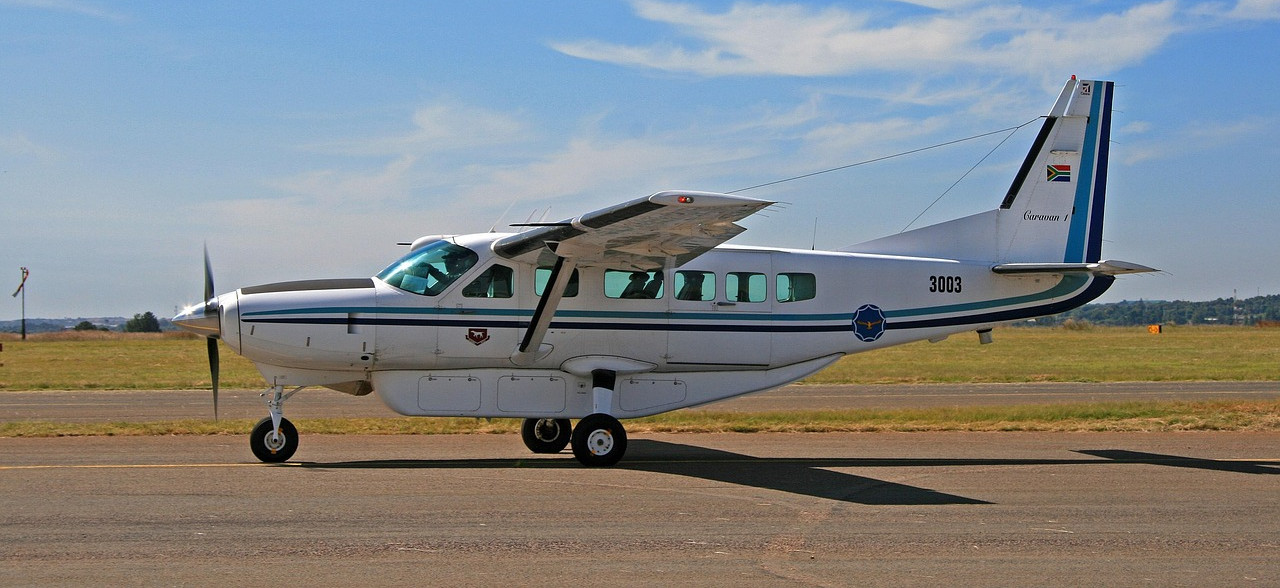
Cessna CaravanImage: Pixabay
The atmosphere
The atmosphere consists primarily of molecules of nitrogen and oxygen. This mass of 'air' is pulled toward the center of the Earth by the force of gravity. These molecules and, therefore, the atmosphere have inherent inertia and a force applied to them/it by gravity.
Gravity
In my opinion, to achieve flight, a heavier than air winged aircraft utilises the atmosphere in order to raise itself above the surface of the Earth. It remains subject to gravity but as long as it applies sufficient airspeed and appropriate angle of attack, the craft will remain above the Earth's surface. The atmosphere in this case is merely a physical extension of the Earth.
In my view there are two things that lead to the air being highly resistant to an object moving through it at speed: the inertia of the molecules it is comprised of and the gravitational pull on them.
Fundamentals
I believe we must delve into the basics of 'aerofoils' whether they are wings on an aircraft, blades on a wind turbine or sails on a boat. The only reason they provide movement is that there is less pressure on the side that is not imparting force on or receiving force from the atmosphere.
A sail or wind turbine blade might be considered a 'passive' receiver of force whereas an aircraft's wings or a hand held outside a car window might be considered an 'active' transmitter of force. If there is equal force on both sides of the aerofoil, no movement (or support) will occur.
It follows that a winged aircraft is able to fly because there is less pressure on the top of the wing than on the bottom when an angle of attack is present. However, I believe this pressure difference is simply a natural consequence of having an angle of attack and not because of any special design of the wing.
This is proved simply by the fact that a model aircraft with flat section wings flies. A pressure difference is inherent when a force (often wind) is applied to an aerofoil or an aerofoil applies force to the atmosphere in the case of an aircraft's wings.
Flight
To move through the air above the ground (flight), an aircraft moves air particles out of the way. As an aircraft moves slowly, when taxiing for example, air is easily displaced by the craft. As the aircraft gains speed however, the air becomes incrementally resistant to being displaced due to its inertia.
At a certain speed, dictated by factors such as the aircraft's wing area, weight and air density (and speed), the air will resist the movement of the aircraft to such a degree that it becomes a supportive mass. This force is called Inertial Drag. It is quite simply the air resistance encountered by the aircraft as it moves through the atmosphere.This is the phenomenon that allows for flight.
The drag acts on the aircraft's surfaces that are meeting the oncoming air: most notably, in terms of allowing for flight, the bottom surfaces of the wings. This drag manifests as support of the aircraft and its ability to 'resist' gravity. Airspeed is the factor that is critical to the existence of this phenomenon.
It is generally accepted that the inertial drag resulting from a force applied to the atmosphere is proportional to the square of the velocity of the object exerting the force. Therefore, if the velocity of the object is doubled, the resistive force applied by the fluid is not doubled, but rather, increased by a factor of four.
The resultant air resistance must be at least equal in terms of pressure to the total weight of the aircraft. The force is only sufficient to allow and maintain flight if a certain air speed is attained. The atmosphere is therefore utilised to separate the aircraft from the Earth.
That an aircraft exerts force on the atmosphere during flight (and whilst taking off) is undeniable. Firstly, the forward surfaces of the aircraft exert force whilst the craft is in forward motion. The elevator must exert force if the aircraft is to 'rotate'. As the aircraft is in the climbing phase, the undersides of the wings and fuselage exert force on the atmosphere. In straight and level flight, the undersides of the flight surfaces and fuselage exert force.
So, in all phases of flight, an aircraft obviously exerts force on the atmosphere. Whilst the results of this force are classified as aerodynamic drag, it is obvious to me that a proportion of the force exerted is necessary for flight to be achieved.
Using the Cessna 172 (at maximum takeoff weight) as an example and disregarding the surface area of the underside of the fuselage, in order for it to fly, I believe the wings must exert force on the atmosphere that in turn results in pressure on the undersides of the wings of at least 68 kilograms per square meter. (Figures have been rounded down for simplicity)
In straight and level flight, the aircraft exerts sufficient force on the atmosphere so as its weight is supported and, consequently, it can fly. This force (exerted at appropriate angle of attack and air speed) results in the air being highly resistant to the craft moving through it due to air resistance and consequently it is capable of supporting the weight of the aircraft.
In my opinion, water skiing is highly analogous with flying. The skier and his/her ski/s is only able to rise to the surface when the tow boat pulls him or her at a speed sufficient that the force imparted on the water by the ski/s is sufficient to make the water essentially ‘solid’ due to its inertia and therefore able to resist the force imparted on it by the ski/s. The more velocity an object has, the 'harder' the water becomes when the object comes into contact with it.
There are numerous real-world examples (other than aviation) of the concept of the object exerting sufficient force on the atmosphere and being able to 'fly': water ski jumpers, snow ski jumpers (both of these having the intention of 'flying' to gain distance) and power boats etc. Outboard racing boats in particular, are able to 'fly' in the straights with only a small section of the keel and the engine (essentially the propeller) in contact with the water.
The control of this 'flying' is critical as the results of excessive angle of attack can be disastrous. The 'flying' ends with these examples due to the thrust being dependent on being in contact with the Earth or water. There is no requirement for any special topside design (airfoil shape etc.) in order for 'flight' to occur.
The phenomenon I am alluding to is this: air has mass (it is comprised of molecules) and it therefore exhibits resistance when acted on by a force. The faster an object goes, the 'harder' the air becomes. Air is considered a Newtonian fluid and conforms to certain laws of physics.
IN MY OPINION THIS IS THE PROCESS THAT ALLOWS AN AIRCRAFT TO FLY: not the shape of the wing and how the air conforms to the top of the wing creating a pressure difference. Simply, the force an aircraft imparts on the atmosphere (at sufficient airspeed and appropriate angle of attack) is resisted and, thereby, the weight of the aircraft is supported.
SIMPLE PROOF
The concept explained on this site is easily proved: no need for fancy wing profiles, complicated formulas, wind tunnels or laws of physics etc. If a person holds their hand or a piece of flat material out at arms length and moves their hand or the object around in various aspects, the air is easily displaced and little energy will be expended overcoming any air resistance.
If the person increases their velocity, however, their hand/object will meet an increasing degree of air resistance and an increasing amount of energy will have to be expended to keep the hand/object in position. The least amount of energy will be expended if the hand/object is held so as to provide the least surface area to the atmosphere.
If the person holds their hand/object with a small 'angle of attack' whilst their velocity increases they will encounter an interesting phenomenon. Once a certain velocity is achieved, the hand/object will move upwards as it applies increasing force to the atmosphere and the air in turn resists the force applied to it. Adjusting the angle of attack will change the degree the hand/object moves up.
Exposing close to the full area of the hand/object to the 'wind' will result in the person feeling a great deal of force as the object exerts an extreme amount of surface area and therefore, force on the atmosphere. In this condition, if the object is actually the wings of an aircraft, this is what is commonly referred to as a 'stall'. The craft will climb only if sufficient power is applied otherwise the aircraft will slow and, subsequently, rapidly lose altitude.
If the person reduces the angle of attack, the object reverts back to travelling through the air as efficiently as possibly (due to a minimal degree of drag) and consequently being supported because of the atmosphere resisting the force.
This simple activity demonstrates the mechanism of flight: an aircraft exerting force on the atmosphere and the atmosphere subsequently resisting the force due to its component's inherent inertia. In my opinion this phenomenon is not correctly described as 'lift': rather the craft applies force to and is supported by the atmosphere.
THE PHENOMENON OF AERODYNAMIC STALL
For straight and level flight to occur, the force applied to the atmosphere by the wings (discounting the underside of the fuselage) via their angle of attack and at a sufficient airspeed must be within a range to provide a balance between force exerted and air resistance.
If this angle becomes too great, the aircraft slows (due to air resistance) and the force being exerted on the atmosphere is reduced (and also not appropriately perpendicular to the Earth's surface) with flight then becoming not possible.
A 'stall' results, with the aircraft rapidly succumbing to gravity if necessary adjustments to the angle of attack and consequently the airspeed of the craft are not made.
For the purposes of this discussion we need to define 'stall'. The dominant narrative is that a 'stall' occurs when the wing reaches its 'critical angle of attack' and the airflow on the upper surface of the wing becomes 'turbulent' and consequently does not flow smoothly over the wing.
This situation is accompanied by 'buffeting' of the controls and other control mechanism feedback. This situation imparts a number of structural stresses on the airframe. The aircraft will experience a precipitous loss of altitude and crash unless corrective inputs are made. If a stall occurs at low altitude, the situation may be unrecoverable.
However, the critical factor in this scenario is insufficient airspeed. Whether the pilot has increased the angle of attack in order to maintain height or it is increased due to other factors, excessive angle of attack brings with it a dramatic reduction in airspeed. This is because of the air resistance of the wings and fuselage.
Due to insufficient airspeed, the weight of the aircraft is not supported because of the inadequacy of the force exerted on the atmosphere and also because any force exerted is at an angle dramatically away from the direction of the force of gravity.
For those who stand by the adage: 'an aircraft can stall at any airspeed and attitude', I agree that a dramatic increase in angle of attack can be applied at a high speed. However, accompanying this will be a significant reduction in airspeed if the maneuver is sustained as well as the danger of catastrophic structural failure.
N.B. Nearly everyone talks about 'stall' in terms of 'exceeding the critical angle of attack'. I believe, however, the following situation is critical to the entire 'debate': what happens when an aircraft is in straight and level flight and the power is reduced to idle without elevator input?
I am not in a position to carry out this scenario in real life but I think it is fairly obvious that the aircraft will slow and commence a descent (this may be a glide or a 'stall') until it either contacts the Earth or corrective inputs are made. Corrective control inputs may not remedy the situation in time to avoid a crash if the aircraft is close to the ground.
Given that the pilot does not desire a loss of altitude, there are generally two options available. The first is to apply 'up elevator'. This input will only result in sustained recovery of altitude if the second option (addition of power) occurs simultaneously. In the case that more power is not applied during this phase the end result will be a 'stall' due to insufficient airspeed brought about by excessive angle of attack. The aircraft will rapidly lose altitude.
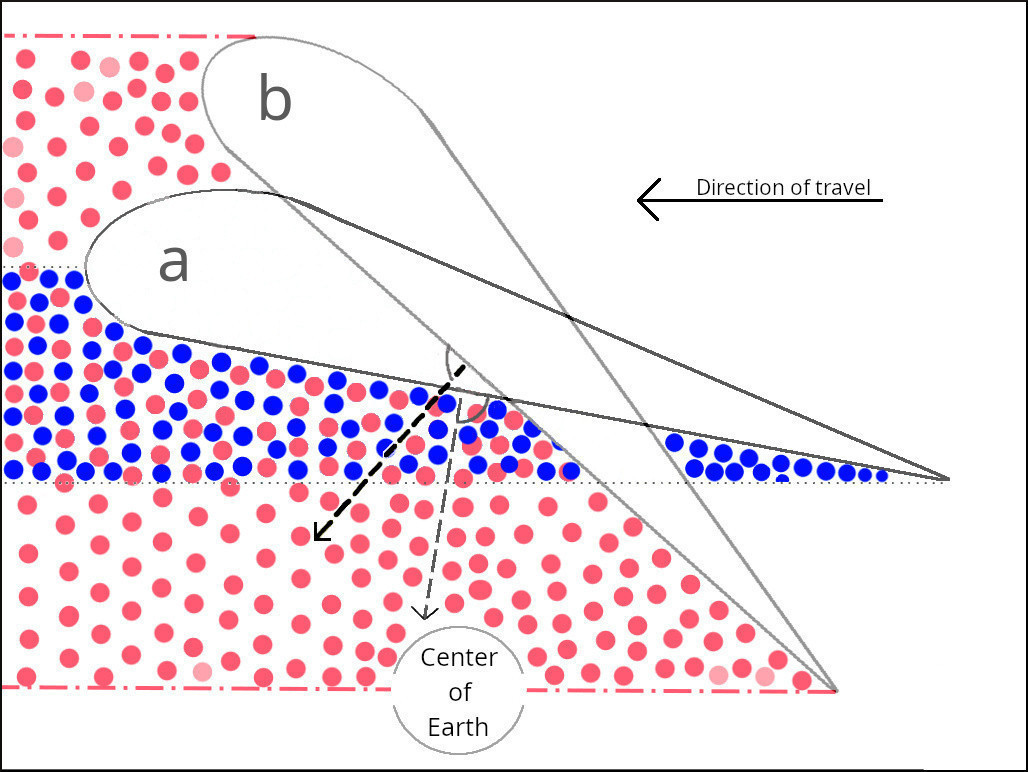
Wing angles of attack. Red and blue dots represent the molecules that comprise 'air'.
When an aircraft's angle of attack increases, the speed of the craft slows assuming it cannot provide more power to create a new 'relative wind'. In the above diagram, Wing A is flying straight and level with an appropriate angle of attack and air speed. Wing B however, has reached a stalled condition with air resistance slowing the aircraft to the point that it can no longer impart sufficient force on the atmosphere (and that force is not directed suitably towards the Earth's center).
A high-powered fighter jet is capable of supplying sufficient power so that a new 'relative wind' is created, allowing it to keep flying with increasingly positive angles of attack. Such aircraft are capable of going nearly vertically up in similar fashion to a rocket.
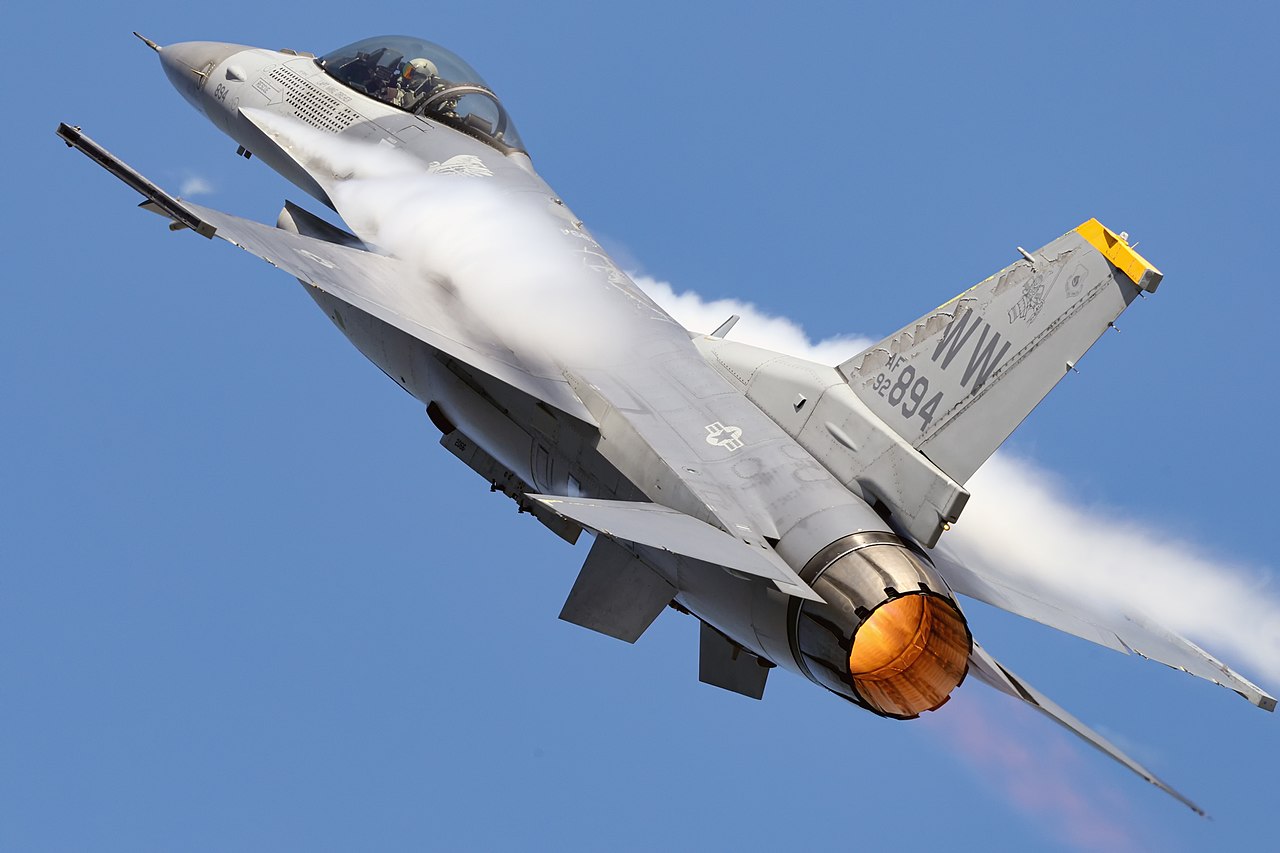
F16 jet climbing at high rateImage: Cp9asngf
Level flight stall
As regards theory for level flight: the wing's angle of attack must be shallow enough so that the wing can:
1. Exert the appropriate force on the atmosphere in order that the craft's weight is supported thereby achieving flight and
2. Offer the least possible surface area to the atmosphere to minimise air resistance (drag).
If the angle of attack is increased without the addition of power, the aircraft's speed will decay due to air resistance and consequently the force exerted on the atmosphere will decrease and also be directed away from the Earth's centre.
The aircraft will eventually not be supported by the atmosphere and will succumb to gravity if corrective measures are not taken.
It is commonly believed that the cause of a stall is the 'boundary layer' on top of the wing becoming 'detached' from the wing's surface (due to excessive angle of attack) with the air subsequently becoming turbulent. This theory seems to be based on the premise that the 'boundary layer' must be 'attached' to the top of the wing in order for flight to occur. I contend that this belief is nonsense.
In the case of an aircraft having stalled (because of the pilot having incrementally increased the angle of attack in a misguided attempt to arrest descent of the craft due to insufficient airspeed) the cause of sudden loss of 'lift' (support) is explained very simply:
Firstly, the 'lift' vector (or what I would call the support vector) is directed away from the center of the earth towards the horizontal via the craft's excessive pitch and therefore away from the direction of the force of gravity. This results in the inability of the craft to adequately support itself (resisting gravity) by exerting pressure on the atmosphere. In other words, the force exerted by the craft's wings (and to a lesser extent its fuselage) is away from the direction of the force of gravity.
Secondly, and this happens as a natural consequence of the above process, the crafts wings, especially, are unable to exert sufficient force on the atmosphere to sustain flight due to the craft's insufficient velocity brought about by the excessive angle of attack and resultant air resistance.
Turning flight and stall
It appears obvious that when an aircraft is in a turn, the wings can only offer less support than when they are perpendicular to the force of gravity as occurs in straight and level flight. It follows that when in a turn with a high degree of bank, the fuselage becomes the predominant surface that is able to offer some degree of surface area with which force can be applied to the atmosphere.
When an aircraft is in a turn using a constant power level and the angle of attack is increased progressively in an effort to arrest descent, the airspeed of the aircraft will reduce (due to air resistance) to a point where flight cannot be sustained. Also, the possibility of structural failure is introduced.
The contribution of velocity
The speed of the aircraft relative to the surrounding atmosphere is, therefore, fundamental to flight. This is why air speed is the key factor to preventing a 'stalled' condition or any situation in which detrimental loss of altitude occurs. Sufficient airspeed allows for the wings and undersides of the craft to exert sufficient force on the atmosphere so as the craft's weight is supported.
Some critical examples of situations in which the airspeed must be sufficient:
- Takeoff: the rotate speed
- Straight and level flight
-
Turning
- Landing: approaching the runway with the intention of landing
In other words, in all phases of flight.
An often heard saying is that an aircraft can stall at any attitude and at any airspeed. I have yet to see on video an angle of attack required for 'stall' applied and sustained until 'stall' occurs (and the airspeed observed) in straight and level flight and at speeds sufficient for cruise speed or above.
POSTSCRIPT
I don't believe it is satisfactory for the aviation community (including academia) to adhere to concepts and laws that may not be correct. Aviation is a far too important area of endeavour to harbour the assumption that the concepts that have been taught for many decades are relevant and correct.